There’s no perfect place to talk about grammar, so I thought I’d talk about it on the train.
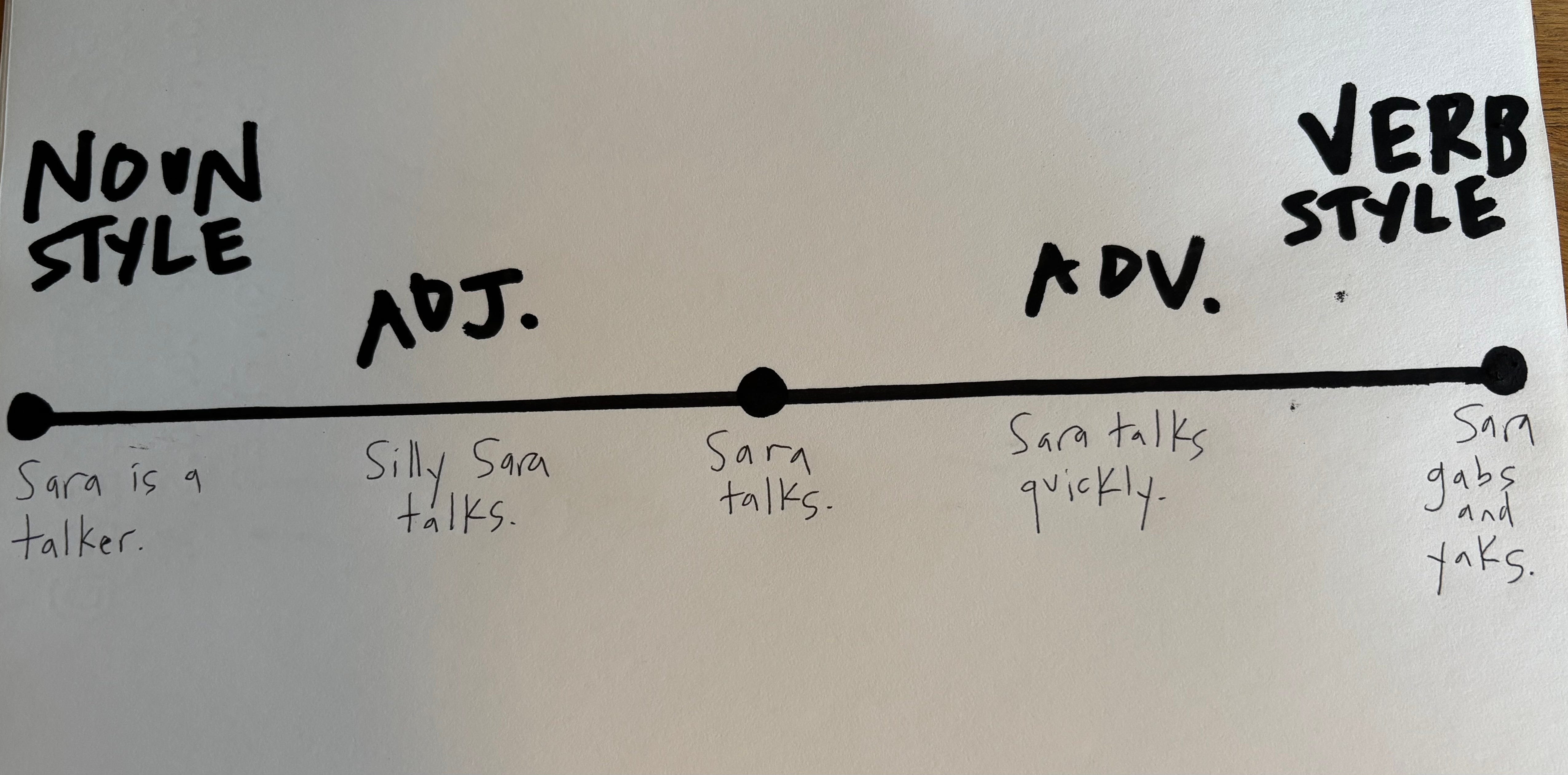
In your average sentence, nouns and verbs do equal work in tandem with each other. But sometimes a writer deliberately unbalances a sentence for rhetorical effect. If you load up on verbs or adverbs, that’s called verb style. If you load up on nouns and adjectives, that’s called nominal style.I don’t think of these styles as a binary, but as a continuum.
High-tech diagram.
For me the exciting question is: How does a chosen style reinforce or modulate the content? Another way of saying this is: sentences tell stories. Is your style helping the story or working against it?
I say “story” but that’s a shorthand. This works for argumentative prose, too.
Sometimes a sentence is “well-written” and “grammatical,” but it doesn’t evoke the feeling you want to evoke in a reader. That’s where understanding noun and verb style can help you. First stop on the grammar train, check the balance between noun and verb!
Small Exercises for the active learners in the house. You know who you are.
1: Pull out a piece of your writing; pick a sentence; count the nouns and the verbs. Check to see if the sentence is in balance—or should be out of balance.
2: Choose a verb and convert it into a noun. Choose a noun and convert it into a verb. (“Choose” converts to “choice.” “Convert” converts to “conversion.)
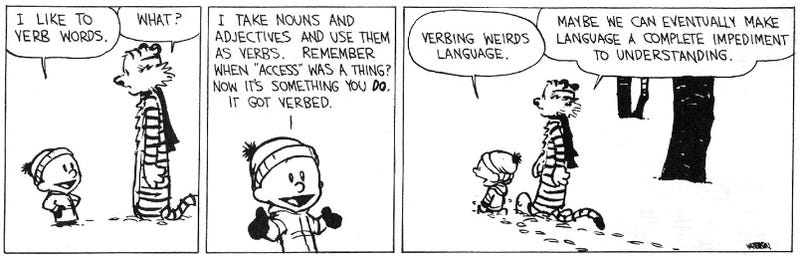
3: See if you can make a noun behave like a verb, or a verb behave like a noun. Linguists call this conversion or Functional Shift. I call it fun.
Taming of the Shrew: “I warrant him, Petruchio is Kated.”
King Lear: “He childed as I fathered.”
Timon of Athens: “Come, sermon me no further.”
Calvin and Hobbes:
Deep respect for those who skim exercises, knowing they’ll never do them. I just close-read Eric Kim’s Orzotta Alla Carbonara recipe, but will I ever cook it? No. I do love Kim’s Lemon-Turmeric Crinkle Cookies, and the video where he shows you how to bake them.
(Insanely delicious! Like a cross between a lemon cookie and a powdered sugar donut.)
Thanks for tuning in! Let me know if you have questions.
Discussion about this video
Delusions of Grammar Podcast
Revision is 99 percent of writing. Novelist Sara Levine makes up that statistic and then talks to other writers about how they do it.
Photo: Jeffrey Kurysz
Revision is 99 percent of writing. Novelist Sara Levine makes up that statistic and then talks to other writers about how they do it.
Photo: Jeffrey Kurysz